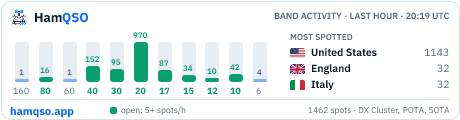
Band activity now
How many spots each HF band has had in the last hour, counted across the DX Cluster, Parks on the Air and Summits on the Air and refreshed every ten minutes. A band with five spots or more in the hour is marked open.
Open now: 80m, 40m, 30m, 20m, 17m, 15m, 12m, and 10m. The busiest band is 20m, with 935 spots in the last hour.
In the last hour HamQSO received 279 DX Cluster spots, 1,176 from POTA activators and 11 from SOTA summits.
| Band | Last hour | Last 24 hours | Status |
|---|---|---|---|
| 160m | 1 | 6 | Quiet |
| 80m | 13 | 39 | Open |
| 60m | 0 | 2 | No spots |
| 40m | 165 | 305 | Open |
| 30m | 102 | 169 | Open |
| 20m | 935 | 2,050 | Open |
| 17m | 101 | 217 | Open |
| 15m | 37 | 77 | Open |
| 12m | 8 | 40 | Open |
| 10m | 54 | 86 | Open |
| 6m | 3 | 5 | Quiet |
Updated at 20:34 UTC. This page is rebuilt every ten minutes.
Most spotted entities
The DXCC entities with the most spots in the last hour. Each name leads to its page, with prefixes, zones, local time and the heading from your locator.


Is the band open?
Is 20m open right now?
Yes. 20m has 935 spots in the last hour, at or above the five that mark a band open here. Stations are being heard and reported on it.
Is 40m open right now?
Yes. 40m has 165 spots in the last hour, at or above the five that mark a band open here. Stations are being heard and reported on it.
Is 15m open right now?
Yes. 15m has 37 spots in the last hour, at or above the five that mark a band open here. Stations are being heard and reported on it.
Is 10m open right now?
Yes. 10m has 54 spots in the last hour, at or above the five that mark a band open here. Stations are being heard and reported on it.
How to read these numbers
Every minute HamQSO reads the DX Cluster, the Parks on the Air spots and the Summits on the Air spots, the same feeds the app shows. Each new spot is counted once, by band and by hour, and nothing else is kept: no callsign, no frequency, no comment. The table adds the current hour to the share of the previous one that falls in the last sixty minutes.
A spot means someone heard a station and reported it, so the count measures activity, not a propagation forecast. A busy band is one where contacts are being made right now; a silent band may be open with nobody on it, or closed. Solar indices such as the solar flux and the K index tell you why a band behaves as it does; spots tell you what is happening on it.
Counts follow the operators. Europe and North America in daylight, a weekend full of park activations or a contest on 40 and 20 metres all raise the numbers, and the night empties the high bands. Compare the last hour with the last twenty-four to see whether a band is waking up or fading.